

SOURCE OF DATA
The distribution data comes from five different sources:
- Literature research (publications, grey literature)
- Fish species registers of the German federal states published in written form
- Database queries from fish species registers of the federal states
- Citizen science data (data entered directly into the atlas, not published elsewhere)
- Other databases
1. Literature research: Both publications and so-called grey literature, such as expert reports, information material and student theses, are evaluated. The prerequisite for the inclusion of data is that the species, location and time are clearly stated.
2. Fish species registers: Fish species registers published in written form by the German federal states were manually converted into distribution points. Insofar as geographically correct distribution points were specified in the registers, a certain degree of inaccuracy was unavoidable during the transfer due to the scale. For registers with distribution information in the form of TK 25 quadrants, the centres of the respective map sheets were determined and the distribution point was set there. This can be seen in the atlas in the strictly geometric grid of distribution points (Fig.); the points are also mostly located outside of bodies of water.
3. Database queries: We received database extracts from the state registers of Mecklenburg-Western Pomerania and North Rhine-Westphalia as well as from the Austrian Federal Institute for Water Management (BAW).
4. Citizen science data: We refer to data that is entered directly into the atlas and has not been published or reported elsewhere as citizen science data. Registered users can enter data. Before the data is activated (i.e. made visible in the atlas), it is checked for plausibility. This can also be done in the form of photos sent along with the data.
5. Other databases: These include, for example, databases from museums (ichthyological collections) or research institutions. For marine fish, we were able to access the PANGEA database, for example.
ACCURACY OF DATA
The location is specified precisely in the form of coordinates. In the case of vague information (e.g. location specified as ‘in Lake Constance’), the point is placed in the centre of the geographical unit based on visual inspection. In the database, the point can be given a degree of uncertainty in metres. The most accurate time specification is the day of the record. The system also accepts month, year or even time span (e.g. ‘20.06.1999 – 06.02.2005’). For the latter options, the system always sets the date of evidence to the first day of the month, year or period. In the above example, ‘20.06.1999’ is displayed; for year entries, the first day of the year is always used (entering “2013” results in ‘01.01.2013’).
CURRENCY OF DATA
Literature data is reviewed regularly but not consistently or systematically. Data provided by third parties may be subject to delays due to work-related reasons. The editorial team is endeavouring (now that the system is working again after a long period of downtime; note: as of October 2019) to quickly incorporate any outstanding items. In some cases, only the older editions of the fish species registers of the federal states that were available at the start of the project have been taken into account (Table). No update was carried out, as the aim for the future is to request data electronically. However, this first required the system (database, web presentation) to be revised. This has now been done with the ‘Biodiversity Warehouse’ software architecture (as of the end of 2019).
SOURCE REFERENCES
Each distribution point is stored with a source reference and corresponding reference number. This appears in full text when the mouse is moved over it.
The data source always appears when a distribution point is clicked on. For more recent entries in the system, an interactive ref. ID appears next to the short citation, which displays the full citation when you hover over it with the mouse (fig.).
Display of the reference …
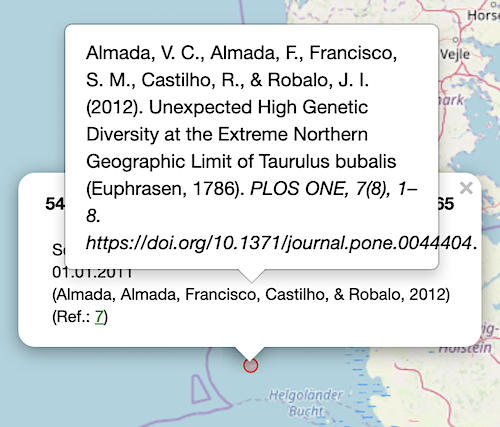
… when hovering over the reference ID (Ref.: 7).
Editorial team Austria
The editorial team for Austria is led by Prof. Dr. Robert Patzner, University of Salzburg. We are grateful to the Federal Office for Water Management (BAW), Mondsee, for providing the majority of the Austrian distribution data. This data is marked as FDA (Fish Database Austria) in the source references. The last query was made in 2015.
Fish species register of the German federal states
The ‘Fish Species Atlas’ project began with the idea of creating coherent distribution maps, initially for Germany and then for both countries together, and making them available on the internet. From the outset, the fish species registers of the German federal states were an important source of data. As the medium-term goal is to also query the data from the fish species registers digitally, in many cases the data is not up to date in order to avoid unnecessary duplication of work through manual data transfer. The following overview shows the update status.
COMPLETE BIBLIOGRAPHY
A complete bibliography is available here:
https://biodiv-atlas.de/fische/#!/statistics/show/publications
DATA STRUCTURE
The distribution maps are based on distribution points. A distribution point indicates the occurrence of a species at a specific time and place. The data is organised in the form of records (e.g. ‘catch’, “observation”, ‘sampling’). Several species can be assigned to a record, each of which is assigned a unique record identification number (record ID). In the data model, a distinction is made between
- species-specific data (status, comments) and
- record-specific data (location, time, method, comments)
Not all details of a data record (e.g. frequency, comments) are displayed in the distribution maps for the species descriptions. However, they can be used for further evaluations when querying the data. The ability to filter and export data may depend on the user’s rights of use.