

Flexible camouflage of Scorpionfishes: adaptation to background patterns
By Leonie John, 2024
“Scorpionfishes are very abundant in the Mediterranean Sea and are also commercially important. Nevertheless, there is little research on this family, especially on these two species.”
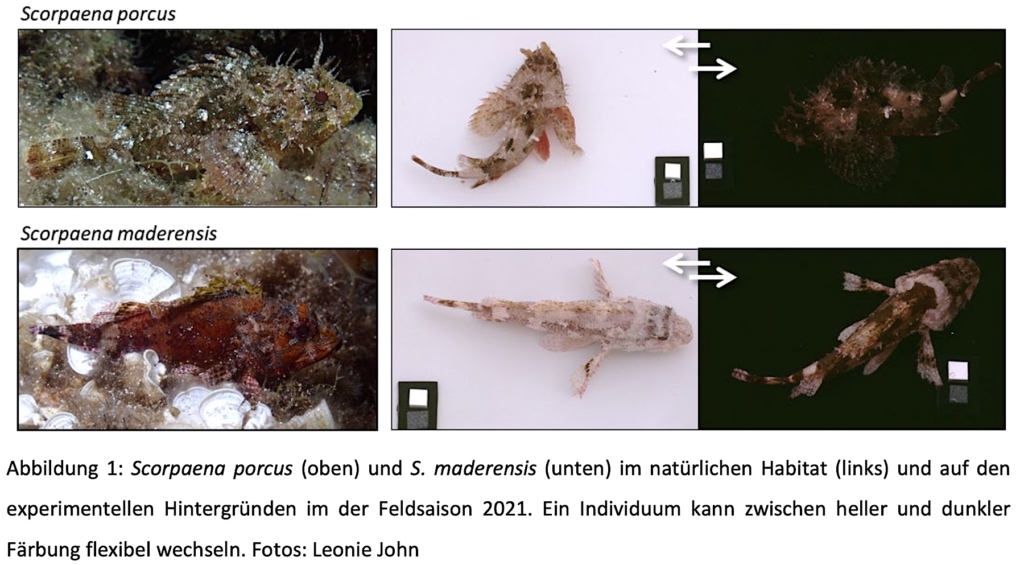
Ambush predators such as fish of the scorpionfish family rely on good camouflage in their environment to hide from prey and hunt successfully. Some fish are even able to change the colour and pattern of their bodies flexibly and in just a few seconds to better adapt to a changing background.
With our experiments, we want to show how flexibly scorpionfish can adapt to their environment. These fish camouflage themselves not only from other predators, but above all from their prey. The physiological mechanisms and behaviours that contribute to their camouflage are therefore important for a better understanding of predator-prey interactions in benthic marine fauna.
In a study conducted in the summer of 2021, we were already able to show that scorpionfish of the Mediterranean species Scorpaena porcus and Scorpaena maderensis adapt their colouration to the background within seconds in order to be better camouflaged in the eyes of their prey fish. The fish changed their brightness when placed on three different light backgrounds. In addition, we observed a change in colour. The fish became redder when placed on a red background. The brightness and colour adjustment appears to be controlled by different cells (at least two types of chromatophores).
Full report
John, L. (2024). Flexible camouflage of dragon heads: adaptation to background patterns. PDF 403 kb
GfI Kleinprojekt Bericht Leonie John 2024
References
John, L., Santon, M., & Michiels, N. K. (2024). Scorpionfish adjust skin pattern contrast on different backgrounds. Ecology and Evolution, 14:e11124, 1–13. https://doi.org/10.1002/ece3.11124
John, L., Santon, M., & Michiels, N. K. (2023). Scorpionfish rapidly change colour in response to their background. Frontiers in Zoology, 20, 10, 1–15. https://doi.org/https://doi.org/10.1186/s12983-023-00488-x
Text and background photo: (c) Leonie John