

‘Digital Biodiversity Atlas – Open Access Presentation of Faunistic Data on the Internet’ with the ‘Fish Fauna Online’ project is an official project of the UN Decade of Biodiversity.
The project ‘Digital Biodiversity Atlas – Open Access Presentation of Faunistic Data on the Internet’ was designated an official project of the UN Decade of Biodiversity on 21 November 2013! The award is given to projects that demonstrate exemplary commitment to the conservation of biological diversity. This honour recognises the commitment of Prof. Dr. Heiko Brunken (Faculty of Natural Sciences and Technology) and Prof. Dr.-Ing. Heide-Rose Vatterott, M.Sc. Martin Winkler and B.Sc. Carl-Heinz Genzel (Faculty of Electrical Engineering and Computer Science) for their many years of work on databases and internet platforms for the protection of biological diversity. The award is also given to the Society for Ichthyology and the Brazilian partner universities UFPE and UFRPE in Recife for their exemplary contributions to the distribution and biology of fish in Germany and Brazil.
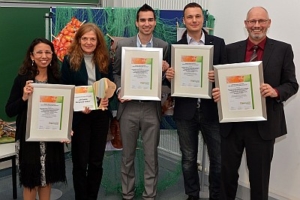
From left to right: Prof. Dr. Glícia Calazans (UFPE, Recife, Brazil), Prof. Dr.-Ing. Heide-Rose Vatterrott, B.Sc. Carl-Heinz Genzel, M.Sc. Martin Winkler (Hochschule Bremen, Informatics) and Prof. Dr. Heiko Brunken (Hochschule Bremen, Biology and German Ichthyological Society)
The ‘Digital Biodiversity Atlas’ is a software package specially developed for the presentation of distribution data. This ‘toolbox’ of current WEB 2.0 technologies for setting up decentralised, server-based expert networks makes it easy to combine digital distribution maps with additional, species-specific specialist information, e.g. on biology, protection and endangerment, photos or literature for specific animal groups and defined regions, and to present them on the internet in the form of so-called ‘atlas projects’. The project follows the idea of ‘citizen science’ (i.e. the involvement of appropriately qualified citizens) and in this form builds bridges between scientists, academically trained experts and committed citizens. The guidelines for the design of the project included scientific quality assurance, compliance with data standards to avoid isolated solutions, high performance on the internet and continuous transparency in the data flow, with particular attention to the copyrights of participating individuals and institutions.
The internet portal ‘Fischfauna-Online – Digital Fish Species Atlas of Germany and Austria Vers. 2.0’ of the Society for Ichthyology (GfI) is the flagship application of this new software solution. With the support of the Society and its members, this project realises the statutory objectives of the GfI, in particular the promotion of research into fish biology, support for ichthyological teaching, cooperation at national and international level with institutions, groups and interested individuals, and the promotion of communication between people involved in fish research.
Information on the UN Decade of Biodiversity and the competition
The UN Decade Project award is part of the activities surrounding the UN Decade of Biodiversity, which was proclaimed by the United Nations for the period from 2011 to 2020. The aim of the international decade is to halt the global decline in biodiversity. To this end, the German UN Decade aims to promote social awareness in Germany. The term ‘biodiversity’ refers to the entire spectrum of life on Earth. This includes the multitude of animals, plants, microorganisms and fungi, as well as the genetic diversity within these species. But their various habitats and complex ecological interactions are also part of biodiversity. A decline in this diversity has been observed for decades. This also means that the valuable basis of life for us humans is dwindling. The aim of the UN Decade of Biodiversity is therefore to inspire more people to take an interest in nature and motivate them to preserve biological diversity. Recognising exemplary projects can contribute to this and encourage people to get involved. Since June 2012, exemplary projects for the UN Decade of Biodiversity have been presented. Since October 2011, the office of the UN Decade of Biodiversity has been based at the Centre for Environmental Communication of the German Federal Environmental Foundation.
Contact persons at the UN Decade of Biodiversity office: Dr Ute Magiera, Project Manager, Dr Natalie Bergholz, Angela Krumme, An der Bornau 2, 49090 Osnabrück, 0541 9633955, u.magiera@dbu.de; www.un-dekade-biologische-vielfalt.de.