

The collective wave of sulphur mollies – arms race between predator and prey
A small-scale project funded by the German Ichthyological Society (GfI)
Text and funding recipient: Korbinian Pacher
The collective wave as anti-predatory behaviour
On the border between the southern Mexican states of Tabasco and Chiapas lies the Hacienda los Azufres, where hot geothermal springs bring hydrogen sulphide-rich water to the surface. These springs drain into a local stream, which this makes a highly toxic environment for most aquatic organisms. However, two fish species have adapted to this extreme habitat in the course of their evolution: the broad-mouthed gambusia (Gambusia eurysthoma) and the sulphur molly (Poecilia sulphuraria). How and why these two species in particular are able to survive in the highly toxic sulphur water has been a subject of interest to ichthyologists and physiologists for two generations, but the uniqueness of these small livebearing fish does not end there. Sulphur mollies and their relatives have another characteristic that makes them unique in this form: their anti-predator behaviour, the collective wave (Fig. 1).
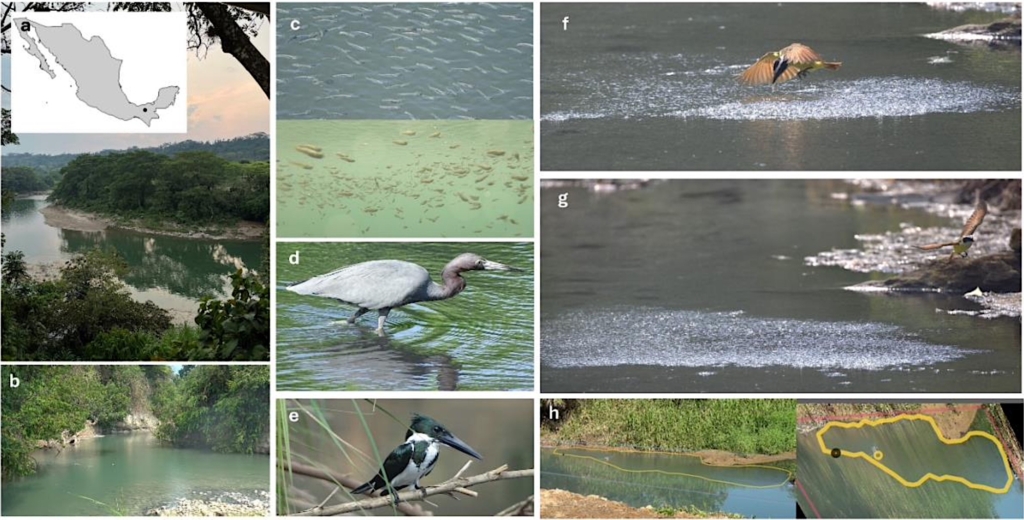
Figure 1: Observation of predator-prey interactions. (a) Typical freshwater habitat in southern Mexico. (b) Sulphur river at Hacienda los Azufres and habitat of sulphur fish. (c) Poecilia sulphuraria breathing at the surface (top) and diving collectively (bottom). (d) Blue heron (Ardea caerulea) hunting sulphur mollies. (e) Amazonian kingfisher (Chloroceryle amazona) hunting sulphur mollies. (f) Kiskadee (Pitangus sulphuratus) in a flight attack on a swarm of sulphur mollies. (g) Collective surface wave in response to a predator attack. (h) Computer-assisted rectification of a video recording from the field.
Living in toxic hydrogen sulphide and with plenty of predators above
As if toxic hydrogen sulphide weren’t enough, sulphur mollies also have to contend with extreme temperatures of up to 36 °C in their habitat, which, together with the sulphur, remove all dissolved oxygen from the water. As a result, sulphur fish have to spend most of their day at the surface, where the top layer of water still allows them to breathe through direct contact with atmospheric oxygen. In doing so, they form huge swarms of up to a million fish bound to the surface. Although their toxic environment protects them from predatory fish, the huge shoals of fish are easy prey for over twenty different species of birds. To counteract this immense predation pressure, sulphur mullets have developed a very special behaviour: as soon as a bird attacks, the members of a shoal collectively dive down. The movement of their tail fins creates a surface wave that can reach an area of dozens of square metres within seconds. As the fish have to return to the surface, this collective diving is repeated for up to two minutes. This phenomenon not only looks impressive, but also has an effect on the predator, which waits longer before attacking again and becomes less accurate. From a scientific point of view, the collective waves are therefore a perfect opportunity to study swarm behaviour as a form of predator defence in nature.
Research project Predator-prey interaction
This research project therefore deals with the predator-prey interaction between various birds and swarms of sulphur-coloured moths. There is a particular focus on the arms race between the two parties. At the end of the project, we hope to have found answers to the following questions:
- Does the collective wave act as a predator defence that is generally equally effective for different and very diverse birds, or is it a specialised response to a specific group of predators (e.g. herons or kingfishers, see Fig. 1d;e)?
- How do factors such as flock size affect the effectiveness of the collective anti-predator strategy?
- What options do predators have to maximise their hunting success despite the collective defence of their prey, and are there species that have found a successful counter-strategy?
These questions begin with targeted field observations using cameras and binoculars. In Berlin, various approaches from computer science then enable us toA special focus of our project is also on collaboration with researchers from Mexico. Thanks to many years of cooperation with the local university in Villahermosa, it has become established practice for local students to regularly assist us with fieldwork. In recent years, the project has benefited considerably from their expertise on local ecosystems. Since then, we have been trying to establish and promote a bilateral transfer of expertise through an exchange programme between Villahermosa and Berlin. From our point of view, this is inevitable, as the extreme ecosystems in southern Mexico are facing an acute threat from various anthropogenic factors due to the lack of any local protection status. Only through close cooperation and the sound training of local researchers can the local public be sensitised to this issue and sustainable cooperation on an equal footing be established. As Western scientists, it is our collective responsibility to contribute to this.
Contact
https://www.korbinianpacher.com/
Publications
Bierbach et al., 2025, Collective escape waves provide a generic defence against different avian predators. https://doi.org/10.1098/rsos.241055
Publishing: Heiko Brunken, 06.10.25
Translation: DeepL