

The GfI Fish Species Atlas provides a comprehensive tool for communicating and exchanging information on fish ecology and distribution data. Details and background information have now been published in an article in the Bulletin of Fish Biology:
The GfI-Fish Atlas – a digital tool for ichthyofaunistics
Heiko Brunken, Lars Braubach, Matthias Hein, Iris Woltmann & Heide-Rose Vatterrott (2026): Der GfI-Fischartenatlas – ein digitales Werkzeug für die Ichthyofaunistik. (The GfI-Fish Atlas – a digital tool for ichthyofaunistics). Bulletin of Fish Biology, 21: 63-75. DOI 10.53188/BFB0016.
https://www.ichthyologie.de/wp-content/uploads/2026/03/Brunken_etal_2026_GfI-Fischartenatlas_BullFishBiol.pdf

Summary:
The GfI-Fish Atlas represents a comprehensive digital tool for documenting and analysing the fish fauna of Germany and Austria. It is based on an open-access online portal that has been developed over the past two decades and currently comprises 283 fish species with 136,242 distribution records. Its foundation lies in heterogeneous data sources, including historical and contemporary state fish species catalogues, ichthyological literature, digital databases (e.g. GBIF, OBIS, PANGAEA), citizen-science observations, and personal communications. All data are quality-checked, georeferenced, and made publicly accessible. The species pages integrate taxonomic, ecological, and conservation-related information, as well as diagnostic characters and bibliographic references. The underlying software architecture, “Biodiversity Warehouse”, was developed at the City University of Applied Sciences Bremen and incorporates modules for geospatial data processing, data persistence, REST interfaces, mobile data acquisition, and user management. Long-term data security and accessibility are ensured through hosting by the LIB – Museum Koenig Bonn. Export functionalities (e.g. to GBIF) support integration into national and international biodiversity networks. The results highlight the considerable importance of digital distribution atlases for ichthyofaunistic research, particularly against the backdrop of a decline in traditional faunistic publications. The atlas enables transparent access to verified data, supports scientific and administrative applications, and promotes engagement by citizen scientists. At the same time, certain challenges persist, including technical limitations in handling large datasets. Overall, the GfI-Fish Atlas demonstrates the potential of digital, community-supported biodiversity databases to visualise current distribution patterns across regions, to support research and conservation efforts, and to improve long-term documentation of the native fish fauna.
Key words: fish species register, Germany and Austria, distribution maps, species descriptions, Biodiversity Warehouse, biodiversity informatics
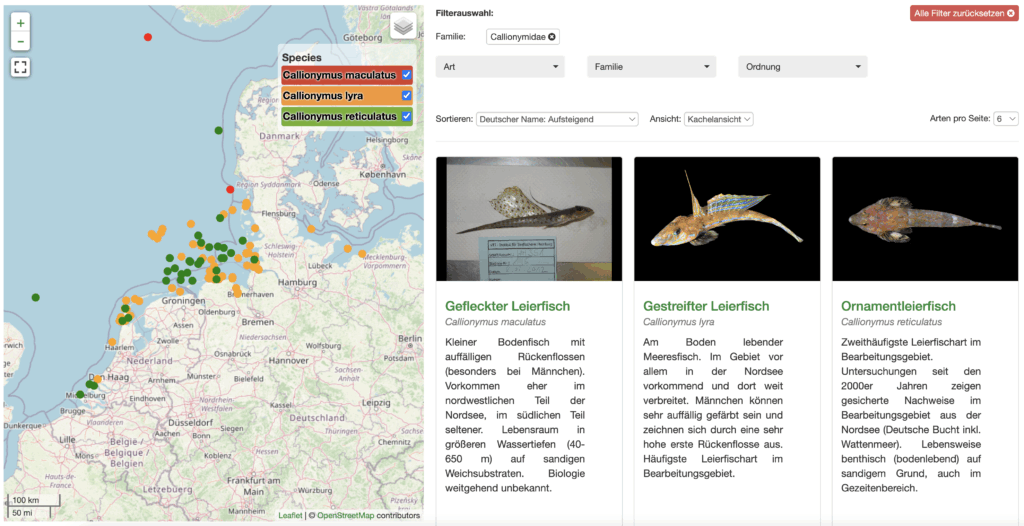
Screenshot from the GfI Fish Species Atlas: ‘Search results for the family Callyonimidae. Tile view.’
Visit the Atlas:
https://biodiv-atlas.de/fische/#!/home
Visit the ‘Bulletin of Fish Biology’:
https://www.ichthyologie.de/1119-2/?lang=en