

Joint press release from the Biological Centre of the Academy of Sciences of the Czech Republic, the University of South Bohemia in České Budějovice, TU Dresden and the Saxon State Foundation for Nature and the Environment, dated 1 July 2026:
Cross-border project to study fish stocks and aquatic ecosystems in the Ore Mountains
Over the next three years, watercourses on both the Czech and Saxon sides of the Ore Mountains are to be comprehensively studied. The aim of a new German-Czech collaborative project is to assess the status of fish stocks and their parasites. This is intended to improve understanding of the impacts of climate change and lay the foundations for the long-term protection of near-natural aquatic ecosystems.
The project is funded under the Interreg Czech Republic–Saxony programme. It is being carried out jointly by experts from the Biological Centre of the Czech Academy of Sciences, the University of South Bohemia in České Budějovice, Dresden University of Technology and the Saxon State Foundation for Nature and the Environment (LaNU).
Exchange between the scientific community, water management, nature conservation and the public
The project focuses on the study of fish communities at a total of 80 sites in watercourses in the Ore Mountains. The scientists are building on successful research into a population of brown trout in the Bohemian Forest (Czech Republic) and extending this to the entire cross-border water regions. In addition to scientific research, the project places particular emphasis on dialogue between the scientific community, water management bodies, nature conservation organisations and the public. Specialist workshops, field trips and other information events are therefore planned. Furthermore, concrete measures to improve bank structures and riverbeds are to be developed and implemented in collaboration with the stakeholders responsible for watercourse maintenance.
The project’s kick-off conference will take place on 25 August 2026 at the Riedelhof (Eubabrunn) in the Vogtland region of Saxony. As part of the event, participants will also visit the freshwater pearl mussel interactive museum in Adorf and the LaNU freshwater pearl mussel breeding station in Raun.
“The Ore Mountains have undergone profound changes in recent decades. Historical industrial pollution, renaturation measures that have been implemented, and the consequences of climate change continue to shape the existing water bodies to this day. We want to investigate the current state of the fish communities and identify the factors influencing their future development,” explains project leader Petr Blabolil from the Biological Centre of the Czech Academy of Sciences and the University of South Bohemia.
Background
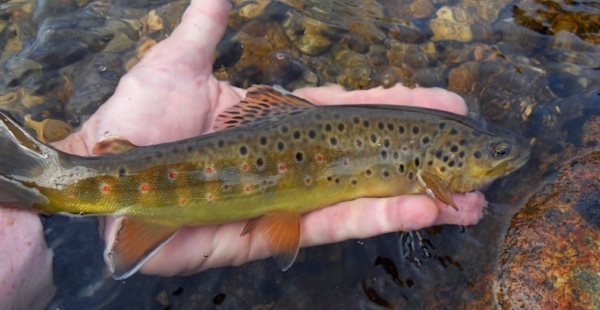
As part of the fieldwork, fish populations are surveyed using scientific methods. Each individual caught is identified, measured and weighed before being released back into the water. A sample of brown trout is examined for parasites.
“The combination of traditional monitoring, genetic methods, parasitology and environmental DNA enables us to gain a unique and comprehensive insight into the functioning of montane aquatic ecosystems in the Ore Mountains. Based on the data collected, we will also identify populations that are particularly threatened by climate change and parasites,” adds Petr Blabolil.
Contact
Christoph Köbsch (TU Dresden)
Photo in the text: Adult brown trout; Organisation: Saxon State Foundation for Nature and the Environment; Publication date: 1 July 2026; Licence status: royalty-free; Photographer: Petr Balbolil
Background photo: Near-natural watercourses as a habitat for brown trout; Photographer: Petr Balbolil; Source: https://www.medienservice.sachsen.de/medien/news/1098451