

Become a fish detective in three days:
Become a fish detective in three days
Project: ‘Molecular Ecology – eDNA metabarcoding for the identification of bony fish species’
Thanks to a unique workflow developed at the University of Trier, even young people can now accurately identify the diversity of bony fish species in a body of water.
No in-depth knowledge of molecular biology is required. You don’t even need to have seen a fish. To determine which bony fish are present in a body of water, all you need is:
– a water sample containing minute traces of DNA (so-called environmental DNA or eDNA).
– a laboratory workshop lasting around three days.
This is made possible by a new workflow developed by the ‘Biology and its Didactics’ department in collaboration with the ‘Biogeography’ department at the University of Trier.
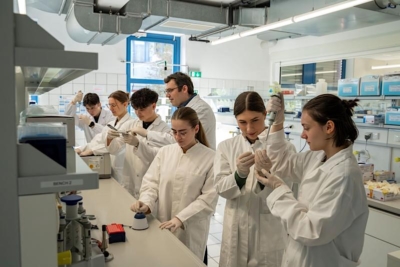
Pupils from Trier’s grammar schools analyse samples in the BioGeoLab at the University of Trier. Source: Jonas Henn, (c) Universität Trier
Analyses in record time, at record prices and with a low margin of error
The work steps are so cost-effective, time-efficient and, above all, easy to understand that even upper secondary school pupils are able to apply the required molecular biological methods without errors. “The workflow established in research for so-called eDNA metabarcoding would take around eight days and would be considerably more expensive. For people with little or no laboratory experience, it would also be far more susceptible to misunderstandings, errors and failed outcomes. We rely on different chemicals, modified protocols, alternative equipment and a software solution that does not require advanced knowledge of bioinformatics,” explains Director of Studies Jürgen Kopp, who initiated and led the development of the workflow.
In pilot studies, pupils from grammar schools in the Trier region sampled the River Ruwer, a tributary of the Moselle, for example. In the University’s teaching and learning laboratory (BioGeoLab), they isolated and analysed the environmental DNA of bony fish species. In doing so, they identified both rare and critically endangered species such as the European eel and the grayling, as well as invasive species such as the round goby. They also learned how to interpret unexpected results, for example when environmental DNA from the Atlantic herring was detected. This most likely enters local waterways via fish feed used in trout farming operations.
Raising awareness of environmental protection issues
“In the laboratory practical course we developed, the focus extends beyond the intended integration of theory and practice to include lasting awareness of biodiversity and environmental protection issues,” says Jürgen Kopp. “After all, people will not value what they do not understand – and what they do not value, they will not protect.”
The project is therefore aimed not only at school pupils, but also at university students and teachers. Among other initiatives, a nationwide teacher training course on the project is planned for September 2026.
Citizen science
The project places a strong emphasis on citizen science. All members of the public have the opportunity to participate actively, independently of schools and universities. “Interested individuals, recreational anglers or angling clubs are welcome to contact me if they would like the bony fish populations of a water body of their choice to be analysed,” announces Kopp. “In addition, it is also possible, upon request, to participate practically in the eDNA metabarcoding workflow and the associated research activities in the laboratory.”
The developed workflow was publicly presented for the first time at an international conference in September 2025. Several German and international educational institutions subsequently expressed interest in establishing comparable programmes in their respective regions. Before this happens, however, the aim is first to establish a comprehensive and regular programme within the University of Trier’s teaching and learning laboratory.
The project:
The project “Molecular Ecology – eDNA Metabarcoding for the Identification of Bony Fish Species” is funded by the Ministry of Science and Health of Rhineland-Palatinate. For further information or if you are interested in participating, please contact Jürgen Kopp (koppJ@uni-trier.de).
Wissenschaftliche Ansprechpartner:
Jürgen Kopp koppJ@uni-trier.de